It is impossible to choose favorites. Just throwing that out there.
Favorites from each genre:
Contemporary Realistic Fiction - The Outsiders, S.E. Hinton
Historical Fiction - Tell The Wolves I'm Home, Carol Rifka Brunt
Science Fiction, Fantasy, Dystopia - The Hunger Games, Suzanne Collins
Nonfiction/Information - Burn Journals, Brent Runyon
Adventure/Mystery - Paper Towns, John Green
Diversity/Multicultural/Cultural Differences - Out of My Mind, Sharon Draper
Ranking (best first):
Tell the Wolves I'm Home - complexity of plot, character development, emotional draw
The Outsiders - Endurance of themes, relatability of characters
The Hunger Games - Exciting plot, has a strong female role model
Paper Towns - Great dialogue, humor, elements of self-discovery
Burn Journals - Authenticity
Out of My Mind - While not extraordinarily well-written, this book has a lot of great and relevant messages to convey.
Most likely to be banned: Burn Journals
There are a lot of very heavy thematic elements (suicide, self-harm, sex) woven through the book. There is also a lot of crude language - multiple F-bombs - and an occasionally very negative attitude from the narrator. I think parents/adults who do not take the trouble to read this book will balk at the language and dismiss the content.
Most vivid descriptions of settings: Tell the Wolves I'm Home
June, the narrator, is very adept at describing the world around her in a literal and figurative manner. The title of the book is also the title of a painting that most of the book's plot references at one point or another. The novel itself is really something of an artistic/visual representation of adolescence, struggle, and relationships.
Best book to stimulate research questions: Out of My Mind
The main character suffers from cerebral palsy, and several other characters in the book are afflicted with a disability. I think having students research these and discuss them would promote an elevated level of understanding and empathy. They could also learn a lot about inclusive education and its rationale.
Saturday, June 29, 2013

Wednesday, June 26, 2013
Out of My Mind - Sharon Draper

There are a whole lot of kids out there who are sure they've got it worse than anyone else. Any number of them have shouted about how life's not fair or bemoaned the fact that they don't have the same clothes/games/snacks/what-have-you as the kid next door.
Melody doesn't have it worse than every single kid out there, but she's got most of them beat. She's eleven, outrageously intelligent, has a photographic memory, but can't say a single word about it. She has cerebral palsy, and has essentially no means of communicating with the outside world.
Her parents, especially her mother, know that Melody is not stupid. They do, however, have to accommodate her every need. She cannot feed, clothe, bathe, or even relieve herself without assistance. The only perfectly functional aspects of her body are her brain and her thumbs. Kids at school make fun of her. She's stuck in a separate classroom with all the other kids who don't "belong" in a standard classroom.
Then her school begins the practice of inclusion. As fantastic as this is for Melody, even better is the introduction of a computer that allows her to communicate.
 |
| Communication tools used by people with CP http://www.cp-center.org/ |
After she obtains the ability to communicate - technology may have its negative and stigmatized repercussions, but for Melody, it's a saving grace - her world expands. She tells her parents she loves them. She is able to interact with her teachers and classmates. She tests her way into a competitive academic club.
Still though, kids are kids, and people are people. And, while Melody's limitations are far exceeded by her abilities, it's hard for some of the people in her life to realize that. This book deals with her struggle with that, and how she chooses to rise above it.
Out of My Mind is a wonderfully told story of a truly indelible spirit. There are many times at which someone of lesser character or resolve might have thrown in the towel and resigned herself to her fate. This book has so many lessons for people with disabilities (do not give up, and do not allow your disability to define or limit you) and without (be generous of spirit and of heart, always extend a hand in friendship, and see the person first).
 |
| asdteacher.com |
I'm tempted to make this required reading in my classroom; even if it takes them a semester to get through on their own, and even if they complain that it's too young for them. I could easily see it being something of a "background book" that they might journal about throughout the year. Really, though, I think that it's something that all kids should read at age 11. No one should have to feel the way Melody does, and the amount of empathy her story could evoke in young readers would be invaluable.
I also think it's an important book for educators to read. Some of the attitudes displayed by the adults in this book are appalling - one of the teachers in the special ed. only class plays the same song every day, and has them repeat the same activity over and over again. When she's confronted about it, she claims that it's for the students' own good, it's really all they can handle, and that they like it. Another claims in front of the entire class that if Melody can pass his test, he's clearly made it too easy (Draper).
 |
| http://gycvillage.org/ |
Have any of you read this one? What did you think? I think we should have read this for our previous class instead of the myriad (Nathaniel) handouts about various disabilities and strategies. Using YA Lit to teach might have been a lot more useful and effective. ;)
Breath - Donna Jo Napoli (**tiny spoiler in 1st paragraph**)

Salz lives with his father, brothers, and grandmother (spelled Großmutter - the wacky b-looking thing is a double "s") in 13th century Germany. They farm, and they adhere to the pagan/pseudo-religious customs that have seemingly kept them happy and healthy for ages. Salz and his grandmother are members of a coven that performs various rituals and ceremonies that presumably keep things going in the way that they should/need to go.
 |
| Likely has the same plague. photobucket.com |
Around the halfway point of the book, a strange plague begins to afflict the members of the village and surrounding farms. People begin acting irrationally and doing very strange things. At the same time, rats begin to proliferate and cause no end of trouble for the human and animal populations alike. Salz and his family's way of life and belief system is called into question by the suspicious townsfolk, and things slowly begin to devolve into chaos.
 |
| Look at this peasant kid. He's clearly got his stuff together. http://hawaiidermatology.com/ |
Napoli writes Salz very well. She captures the emotions and thoughts an almost-thirteen-year-old boy might have. He is in turns desperate to keep his family functioning in a time of illness and panic, determined to prove his worth, and afraid of what might happen if he fails at both. To a lesser degree, this needing to prove oneself is very typical of adolescents. Salz's situation is definitely more desperate than the modern pre-teens, but he does the best he can with the resources available to him.
I can see this being a good introductory book to the time period (what living conditions were like, and what the average Joe of the time might have been doing for a living). However, it touched on several things that I would like to have learned a little more about. For example, the collegiate-like atmosphere of the place Salz goes to learn to read was great, but I didn't get a feel for what the place was, specifically. Might it be a precursor to what became colleges or universities?
 |
| I'd add a source, but this has been linked about 3 different times from several different blogs. |
It would also have been cool for the book to explore Salz and his grandmother's coven a little more deeply. The book gives us a taste of this part of his life, but doesn't delve into it excessively, and the author seems to assume prior knowledge of such things. The bottom line is that I would have been happy to read another 100 pages if it meant receiving more back story.
That said, I understand why the author may not have done so, especially if she was gearing it toward younger readers who might want more action than exposition.
I think I'd have this in my classroom library, but I don't know that I'd include it as a part of the curriculum. I know Kelly K really loved this one, and I liked it quite a lot. I just think it would need to go a little bit deeper in order to prove very useful as part of a unit.
 |
| http://myths.e2bn.org/ |
Still, though, it would give kids a very good perspective on what it was like to be a young person in the 13th century. It would also help them appreciate how many more answers we have for things now - as well as how much science can explain and/or fix these days. It would be kind of fun to have them Google the symptoms displayed by various characters in the book to have them figure out for themselves what they might be suffering from.
So, I guess I'm torn. For those who have read this one, what do you think? Would you put this book into your curriculum? To what end?
Thursday, June 20, 2013
The Outsiders - S.E. Hinton

His gang is not much like what one might envision when stacked up against today's idea of a gang. He and his brothers - literal and figurative - generally don't go looking for trouble. They exist as a group to defend one another; to keep each other safe. It's the rich kids, the socs, who rustle up trouble and torment the greasers.
There's a rather significant event about a quarter of the way through the book that has a rather dramatic effect on Ponyboy's life. I won't reveal it here, but suffice it to say that the police get involved. Most of the book deals with the aftermath of that event, and how Ponyboy and his gang cope with it.
One of the biggest questions that gets asked about this book is how it maintains its relevance after nearly 50 years. It's a good question. A lot of the slang has disappeared, as have the fashion references. For the record, this is a madras shirt:
 |
| http://www1.bloomingdales.com/ Modeled by the kind of dude who might wear one. |
 |
| Wikipedia.org Hold on to sixteen...as long as you caaaaan... |
I've also come across the idea of "infinity" several times in these YA books. Charlie wanted to feel infinite in The Perks of Being a Wallflower, and so did Quentin in Paper Towns. When Johnny tells Ponyboy to stay gold (178), I think he's also kind of touching on that idea: to always hold on to a part of your youth; to keep feeling the way you do at 16 as you grow up. I don't mean the insecurities or awkwardness - I mean the feeling that your entire life is rolled out before you with no bad decisions in it and so much opportunity to leave your mark. We should hold on to those last gasps of innocence.
Another enduring aspect of the teenage experience is the massive amount of introspection we get from Ponyboy. He spends a lot of time living inside his own head - everything the reader knows of the world of greasers and socs is seen through Ponyboy's eyes. We feel a lot of Ponyboy's hopelessness about his situation and the world, but toward the end of the book, we also see him begin to realize that not all the lines in his life are as clearly defined as he thought they were.
 |
| www.fanpop.com |
Before a big, pre-planned rumble between the two groups, Ponyboy has a conversation with one of his supposed adversaries, and he comes away from it with the insight that "socs were just guys after all. Things were rough all over, but it was better that way. That way you could tell the other guy was human too" (Hinton, 118).
Hinton portrays a maturity and awareness of the world that I'm surprised came from the mind of a 16-year-old. I think her age, and, whether I like it or not, her gender, could be major selling points in getting kids to read this book. Then again, I really like the idea of waiting until after a class has finished the book to reveal those bits of information.
Either way, I think it's a book I'll at the very least get on a shelf in my classroom. It has a lot of enduring truths to convey, and in language that's quite accessible to everyone. It's a "stick with you" kind of book. I finished it a week and a half ago, and I still catch myself thinking about parts of it.
Has anyone seen a movie version? If so, how does it stack up, and how would you feel about pairing it with a unit about the book?
Wednesday, June 19, 2013
Paper Towns - John Green

Then, one night, his neighbor, Margo Roth Spiegelman (a girl whom he's known since they were both children and loves desperately) shows up at his window with a list of 11 tasks - each more ridiculous and vaguely illegal than the last - and basically orders him to be her chauffer and accomplice for the evening. Because he loves her (or, as we will come to find out, the idea of her), he complies.
The next morning - I won't spoil the exciting scenes from that evening - Quentin goes back to school. Margo is not there. For a few days, no one thinks much of that fact. After all, Margo has disappeared before and come back with outlandish stories:
 |
| It's always the bassist.... http://madeira.hccanet.org/ |
But Margo doesn't come back. What happens throughout the rest of the book is an exploration of both Margo and Quentin. We learn quite a lot about Margo through Quentin's eyes, and the kind of girl she is begins to change as he uncovers more details from the clues she's decided to leave behind. He begins to understand that Margo is human - not an idol or something to be worshipped (via the full three name moniker). He begins to learn that she, like all other people, is imperfect and has feelings. Quentin comes to realize that "Margo was not a miracle. She was not an adventure. She was not a fine and precious thing. She was a girl" (199).
 |
| http://www.tedkurland.com/ |
The first thing that struck me about this book is that it would be a good read for boys. I enjoyed it very much, but there was a coarseness in some of the language that just isn't present in a lot of the YA books geared toward girls. There's swearing and multiple references to male genitalia. We're definitely inside a boy's head, and it's good to see a boy portrayed as insightful, introspective, and as unsure of himself as girls so often are in books.
For many parents/groups, the language in this book might put it into a category of higher risk. Sometimes, the content of a novel justifies the language, and this is one of those times. Generally speaking, this is how high schoolers talk. Some of it was a little over the top (think the dialogue in Juno), but it was entertaining nonetheless.
I think this is a good book for teachers and students alike to read, just for the fact that it takes these teenage stereotypes, breaks them down, and helps the reader see that - niches aside - we're all human, and we've all spent time looking for something (or someone) at some point in our lives.
Sunday, June 9, 2013
Chains - Laurie Halse Anderson

When the novel opens, Isabel and her younger sister, Ruth (who is described as "simple" and suffers from what sounds like epilepsy), are burying their former master. The woman, Mary Finch, granted them their freedom in the event of her death -- something the lawyer charged with dispersing the estate fails to acknowledge or pursue. He sells them to a cruel British couple who are loyal to the crown, and Isabel and Ruth are packed up and shipped to New York.
Isabel is approached by another young slave named Curzon, who implores her to spy on her British family for the benefit of the American Revolution. She initially refuses, unwilling to endeavor the risk.
Then things begin to change. Slowly but surely, a growing number of rights are taken away from Isabel. She even loses her name, instead being dubbed "Sal," since Isabel is not a "slave name." Isabel begins to take risks she didn't think herself capable of taking.
This book reads as you might expect a book written from the perspective of a young slave girl in 1776 would. Isabel is possessed of a fierce will to survive and keep her sister safe, and her thought processes are definitely old for her age. Some of the horrors she experiences are addressed directly and graphically -- nothing anyone over the age of 11 can't handle, though -- some of the more subtle injustices are hinted at (e.g. the loss of her name, the treatment of her sister). It's made very clear that most of the novel's cast views her as subhuman.
Like most historical fiction novels written for young adults, Chains would complement a unit nicely. The author slips in lots of historical facts, and each chapter heading is a quote from the time period that gives an indication of the political and/or social climate. Coupled with non-fiction sources, it could be a very useful tool.
 |
| http://www.humanities.mcmaster.ca/africanhistory/ |
It's not as though Anderson's novel glorifies slavery; it does quite the opposite. It just sounds a lot like all of the other novels about that time period and issue. I also don't mean to suggest that the issue of slavery be dropped from the curriculum -- I think that would be a mistake as well. One thing I really liked about the book was that Anderson strove to emphasize the irony of a country fighting for its freedom while simultaneously refusing to grant the same rights to its slaves.
Bottom line, I think this book would spark lots of discussion in a classroom. Given Isabel's age, it provides an opportunity for empathy with its protagonist, and brings a very individual, human face to slavery that adolescents can connect with. As far as ages go, I think it might be appropriate for middle school, or 9th grade at the outside.
What do y'all think? Knowing what you know about it (whether you've read it or not), would you have your class read this book?
Tell the Wolves I'm Home - Carol Rifka Brunt

It's 1987, and June Elbus is 14. She loves her uncle, an artist who is dying of AIDS -- a disease no one in 1987 really understands yet. Her sister hates her. Her parents never seem to be around. Still, June, her mother, and her sister (Greta) travel to the city (New York) on Sunday afternoons so that her uncle Finn can work on a portrait of June and Greta. June, naturally, treasures these visits while 16 year-old Greta drags her feet. They continue these visits until Finn's death -- which happens early in the novel, so that shouldn't spoil anything for you all. The book's title is also the name of the portrait.
As the story progresses, things are slowly revealed about Finn. From the beginning of the novel, it's fairly apparent that he's gay. What June, along with the reader, comes to find is that he was not living the single life she always assumed he was. The carefully crafted facade Finn maintained for his nieces falls away after his death, and June meets his boyfriend, Toby.
The rest of the book is spent exploring June's relationships with Toby, Greta, and her parents. Brunt is a truly good writer, and manages to capture the feeling and tone of an adolescent girl trying to navigate uncharted waters.
AIDS pops up throughout the novel. June's mother, like most of the country at the time, knows little about it and is very much afraid of it. A result of this fear resulted in increased prejudice and dislike of the gay community. June muses on page 137 about how public perception might change with different "presentation" when she describes a news story on TV:
They segued into a more general piece about AIDS. As usual, they started out with footage of some kind of sweaty nightclub in the city with a bunch of gay men dancing around in stupid leather outfits...It would have been nice if for once they showed some guys sitting in their living rooms drinking tea and talking about art of movies or something. If they showed that, then maybe people would say, "Oh, okay, that's not so strange."
 |
| http://www.tumblr.com/tagged/introverts |
June's an old soul; an outsider. Teenagers, regardless of social standing, spend a whole lot of time inside their own heads. I can see this book being very accesible to them, despite the fact that it's not billed as YA lit in the Madison library system.
Teenagers also feel as thought they're constantly on display, something examined a bit by June when she says that a portrait "is a picture where somebody gets to choose what you look like. How they want to see you. A camera catches whichever you happens to be there when it clicks" (116).
Brunt perfectly captures the agony of teenage embarrassment on page 280:
I lost all my hearing. My head felt filled with every buzzing creature on the planet. I wanted to turn to wax and melt away. I wanted to erase every wrong cell of my body. It felt so bad to be alive in that moment, I would have done anything to end it. If we weren't in the Bronx, I would have jumped out of the car and run all the way home.
 |
| http://sixfootgiraffe.com/tag/faceless/ |
One thing I'd like to explore with a class is the author's decision not to describe June physically, other than to say that she is taller and heavier than her sister. Aside from Finn and Toby, there really aren't any characters in the book that are fleshed out with physical description. We have ample knowledge of their personalities, what motivates them, and how they see the world, but we don't ever get to see what they look like. I would ask my students why this might be, especially considering so much of the book focuses on a portrait of June and her sister. I think this book would be a very good one to explore character development. Its themes -- love, chiefly, but also loss, pain, and self-discovery -- also place it solidly in an adolescent reader's wheelhouse.
I'd highly recommend this one to both adults and high school readers. It would probably be a second semester/quarter kind of book to choose because of its content and risk factor, but with good direction, it could be really fantastic in a classroom.
Thursday, June 6, 2013
The Geeks Shall Inherit the Earth: Popularity, Quirk Theory, and Why Outsiders Thrive After High School - Alexandra Robbins

The book follows the stories of six students and one teacher listed below (descriptions pulled from the author's high-quality website):
Danielle: The Loner, who has withdrawn from classmates since they persuaded her to unwittingly join her own hate club.
Whitney: The Popular Bitch, a cheerleading captain both seduced by and trapped within her clique’s perceived prestige.
Eli: The Nerd, whose differences cause students to laugh at him and his mother to needle him for not being “normal.”
Joy: The New Girl, determined to stay positive as classmates harass her for her mannerisms and target her because of her race.
Mark: The Gamer, an underachiever in danger of not graduating, despite his intellect and his yearning to connect with other students.
Regan: The Weird Girl, who battles discrimination and gossipy politics in school but leads a joyous life outside of it.
Noah: The Band Geek , who is alternately branded too serious and too emo, yet annually runs for class president.
The format of the book switches between narration of the characters' stories and the author's essays. The author follows the characters (who are, after all, real people) throughout the school year and issues them a social "challenge" halfway through. The results are interesting and occasionally frustrating. She asks one student to start randomly approaching various different social groups in an attempt to branch out. The student, who is very shy, essentially refuses - and I can't say I entirely blame him. There were times when I occasionally wondered whether the author had even attended a high school.
The essays discuss things like popularity, group psychology, labels, and misconceptions. They cite various studies and the author reflects on those. I found them to be a bit dry, and ended up having to re-read sections when my mind wandered. They all seemed to basically say the same thing.
I question a few of the author's assertions. She erroneously, like many are quick to do, blames the Columbine shootings on bullying. And, while bullying is rampant in schools and a very serious problem, it's not what caused the events at Columbine High School. Those murders were meticulously planned and executed by a documented psychopath (Harris) who essentially brainwashed a clinically depressed Dylan Klebold. If you're interested, I'd highly recommend Columbine, by Dave Cullen. It's a very chilling read, but the guy spent a full decade actually getting the facts about what happened. Robbins finishes a chapter on popularity by saying that Eric Harris was popular at the school he attended before Columbine, and strongly suggests that it was his lack of popularity at Columbine (which, as Cullen's book highlights, didn't exist - he had plenty of friends and a date to prom) that drove him to kill.
As a side-note, Robbins also references MySpace on multiple occasions, when I'm fairly sure Facebook had taken over social media by 2011, when this was published.
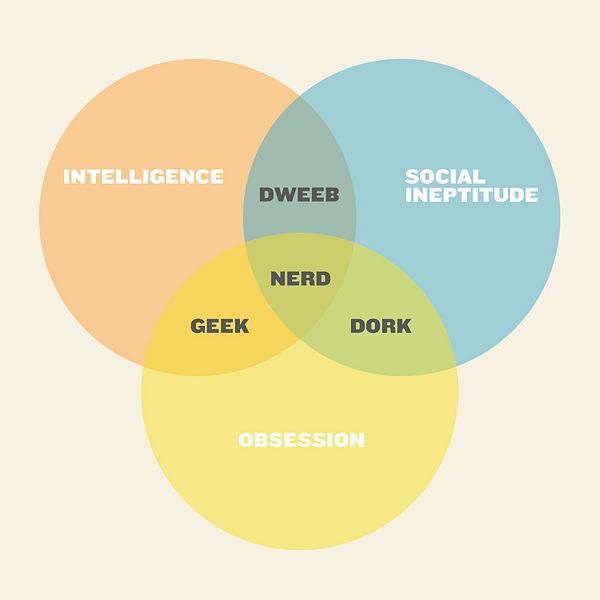 |
| How do you make a geeky thing geekier? Make it a diagram. |
Robbins lumps people - her own descriptions of the kids on her website are evidence of that - into very specific categories, saying only once in the entire text that not all people fit into the groups she's outlined. I appreciate what she's tried to do with this book, to elevate "the little guy" - heck, I was one of those in high school - but I also know that plenty of popular kids excel just as much as the weirdos (again, I am an admitted weirdo) have. Everybody's different, and I really think people don't become who they truly are until after high school. It takes some longer than others, but most people get there.
She finishes the book with suggestions for educators, parents, and students. I really got the most out of this section, to be honest. A lot of what she suggests seems like common sense (don't try to tell kids to be normal...be understanding), but common sense is often hard to come by. A lot of her advice rather flies in the face of what she spent the rest of the book doing.
 |
| Extreme stereotypes? Yes. Still one of the best movies ever. |
What do you guys think? How advantageous do you think it is to assign rigid categories to a student body and then operate off of assumptions you've formed about them - whether they're good assumptions or bad? A complete lack of bias is simply impossible, but there are definite steps you can take to avoid the kind of pigeon-holing outlined in this book.
Tuesday, June 4, 2013
I Am the Messenger - Markus Zusak

One day, Ed receives an envelope. In it is
an ace of diamonds with three addresses written on it. Next to each address is
a time (one is midnight, another 5:30 pm, etc.). Ed eventually finds his way to the first address at the
appropriate time and discovers a "mission" in which he must deliver a
message to an individual associated with the corresponding clue on the card. He
goes on to receive additional cards with increasingly cryptic clues as to the
message he'll need to deliver. Some of them lead to fulfilling experiences, and
some of them are just plain old dirty work. He's also never told what the
message is; it's something he needs to figure out on his own for each person.
The things I like best about this book are the
pacing, tone, and use of figurative language. Conveniently enough, these are
also elements of writing that could easily be added to a lesson plan or unit
surrounding the book.
Zusak doesn't spend very much time making
his readers wait to see what's going to happen next. And,
while many authors have difficulty balancing this kind of action with a
believable and natural plot flow, Zusak manages to do so quite gracefully. There
are a lot of activities available that lend themselves to examining this
technique, and I think this book would be a really great way of introducing
them. The plot is driven equally by dialogue and narration, which would both be
good things to discuss with a high school class.
The tone is very familiar. Zusak has written
the novel in present tense with Ed’s first person voice. The general feeling is
that Ed is speaking directly to the reader. Zusak writes in a comedic tone that
lightens some of the book’s darker themes. Ed, for example, has many
conversations with his dog, The Doorman (yes, that’s his dog’s name). One of
these takes place after Ed’s received a fairly substantial blow to the head.
His dog is the one who brings him back around:
“A big slurp wakes me up.
The Doorman.
Thank God you’re all
right, I tell him. I say it by shutting my eyes with relief.
He slurps again, and his tongue is red from
the blood that’s cracked down my face. He smiles at me.
‘I love you, too,’ I say” (Zusak, 104).
As I mentioned previously, the book is a
great vehicle for introducing elements of really good writing. I would like to
choose a few passages in which the author makes Ed’s personality very clear, ask
students to write a journal entry in Ed’s voice – then one in their own – and compare
the two.
 |
| The Doorman (I've decided this is what he looks like.In the book, he's described as a German Shepherd/Rottweiler/godknowswhat...mix) |
Zusak really seems to enjoy playing with
words. He has a way of describing a scene or action that makes the reader see it in a
completely different way than is considered conventional. A few examples are as
follows:
Ed’s mother abruptly hangs up on him – “No
one can murder a phone call like my mother” (149).
After someone says something very cutting to
Ed – “…which nearly makes me throw my temper from my skin and hurl it at her”
(281).
After Ed says something heavy with meaning – “The words
fall to the floor, to the cards, and Audrey smiles” (344).
Again, I think passages like these could
prompt a lot of discussion and promote some divergent thinking and
interpretation. Trying to come up with creative examples on one’s own is very
challenging, as there are a lot of “dead” metaphors and similes out there. I really loved reading this book because of how disruptive (in a good way) language like this could be. It wasn't disruptive of the story, but it made my mind pull back every now and then to say "well, that was pretty cool."
 The last thing I thought about while reading this novel is its target audience. Ed and his friends are all around 20 years old. Ed is 19, and has fallen upon that wandering, desperate kind of aimlessness that seems to
be so prevalent among twentysomethings. The feeling is also something a lot of
teenagers experience; not knowing who they are or whether they'll ever amount to anything significant. Ed comes through his struggles in one piece, more or less, and his final “message”
could be quite a comfort to anyone reading it.
That said, I’d probably recommend it for high school readers only, as it deals with a lot of hot-button issues (sex, love, violence) that most middle school students may not be well-equipped to deal with. For example, Ed talks several times about how he can smell the sex on another character. There are also several sort of graphic scenes in which Ed gets the stuffing beaten out of him, or does it to someone else.

That said, I’d probably recommend it for high school readers only, as it deals with a lot of hot-button issues (sex, love, violence) that most middle school students may not be well-equipped to deal with. For example, Ed talks several times about how he can smell the sex on another character. There are also several sort of graphic scenes in which Ed gets the stuffing beaten out of him, or does it to someone else.
A final, irrelevant note: I Am the Messenger is written in the voice of a British/Australian person...which gives it an extra 50 cool points.
Final note #2: You should also read Zusak's other novel, The Book Thief. It's fantastic.
Subscribe to:
Posts (Atom)